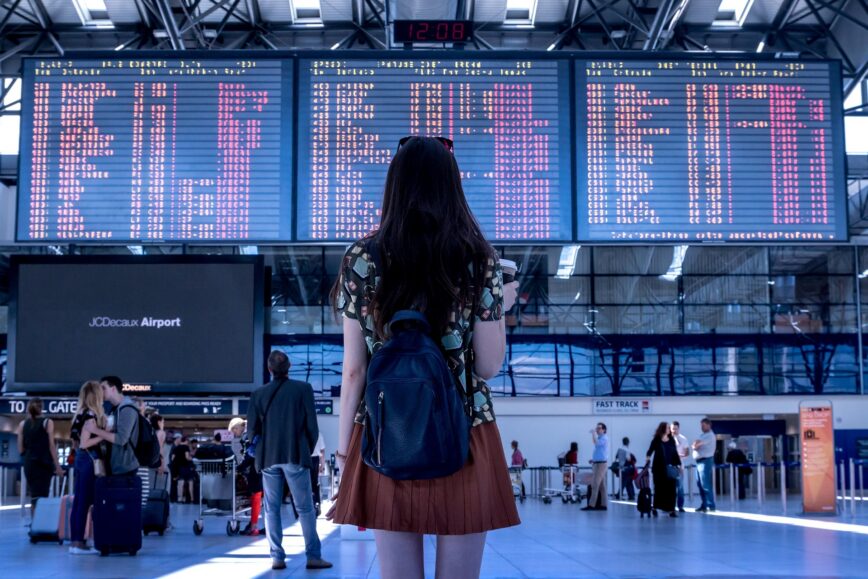
Most travelers should arrive at the airport two hours before a domestic flight and three hours before an international flight. Treat that as a starting point, then adjust for your airport, checked bags, parking, security options, and how much uncertainty you are willing to tolerate.
Airport arrival means reaching the correct terminal. It does not mean turning onto airport property, entering a parking garage, or watching your shuttle disappear into the night.
Use the Airport Math calculator to estimate when you should leave home based on the parts of the trip that actually apply to you.
Quick answer
| Travel situation | Starting point |
|---|---|
| Domestic flight | Arrive at the terminal 2 hours before departure |
| International flight | Arrive at the terminal 3 hours before departure |
| Checked bags | Keep the full starting window and verify the airline’s cutoff |
| Parking or airport shuttle | Add that time before terminal arrival |
| Rental-car return | Add return and terminal transportation time |
| Large or unfamiliar airport | Add extra time for traffic, terminals, and walking |
| TSA PreCheck or CLEAR | Security may be faster, but the rest of the trip stays the same |
| Holiday, outage, or disruption | Add a buffer based on current conditions |
These are estimates, not guarantees. Your airline’s requirements and current airport conditions take priority.
I regularly fly between LAX, EWR, and ORD because I am an LA transplant dating another LA transplant. Seeing family tends to involve one of those three airports, none of which has ever been accused of being a small regional terminal.
What does “arrive at the airport” actually mean?
Your target arrival time should be when you enter the correct terminal with your luggage.
Everything before that needs its own time:
- Driving or taking transit
- Entering airport traffic
- Finding the correct terminal
- Parking
- Unloading luggage
- Waiting for a shuttle
- Returning a rental car
- Taking a train or bus to the terminal
This distinction matters because airport advice usually begins at the terminal. Unfortunately, most travelers begin somewhere else.
I learned not to treat shuttle time as a minor detail after an airport shuttle drove straight past me at 2 a.m. and left. My timing plan did not survive the encounter. A shuttle estimate should include the wait, not just the five pleasant minutes when you are finally inside it.
What can change how early you need to arrive?
The two-hour and three-hour guidelines are useful because they leave room for several separate steps. Your actual trip may need more or less time.
Which airport are you using?
A small airport and a major hub do not create the same trip.
LAX, EWR, and ORD can involve airport traffic, terminal confusion, long walks, trains, buses, and security lines that change quickly. Familiarity helps, but it does not make the airport smaller.
Airport Math currently uses airport-specific planning assumptions for more than 530 airports. Its base security estimate is 35 minutes at LAX and ORD and 30 minutes at EWR. These are planning inputs, not live security wait times or promises about what will happen on a particular day.
I know those three airports better than many others, but familiarity mostly helps me know where the problems are likely to occur. It has not granted me diplomatic immunity from airport traffic.
Are you checking a bag?
A checked bag adds another line and another deadline.
Airline bag-drop cutoffs are not suggested arrival times. They are the latest point when the airline may accept your bag.
For example, Delta’s current domestic check-in guidance recommends arriving two hours before departure and generally requires checked bags at least 45 minutes before departure at most airports. Reaching the terminal at that 45-minute cutoff leaves no useful room for a line, kiosk problem, or walk to security.
If you are checking a bag, keep the full airport-arrival window and verify the cutoff for your airline and departure airport.
Are security lines normal today?
Security estimates can stop being useful when an airport or airline experiences an outage.
I have encountered long security lines during outages more than once. The frustrating part is that your normal routine may be perfectly reasonable right up until the systems stop cooperating.
Before leaving home, check:
- Your airline app
- Your airport’s official website
- Current traffic
- Any reported outages or construction
- Your flight and terminal
- Whether your expected security lane is operating
The TSA’s travel guidance encourages travelers to arrive two hours before scheduled departure. That recommendation is a general starting point, not a real-time report from your terminal.
Do TSA PreCheck and CLEAR mean you can arrive later?
TSA PreCheck and CLEAR may shorten part of the security process. They do not shorten your drive, find a parking space, accept your checked bag, or move your gate closer.
Lane availability can also vary by airport, terminal, and time of day. Confirm that the service you expect is available for your actual departure.
I use expedited security as one input, not permission to plan the rest of the trip down to the minute. Airports are very good at finding a different minute to take from you.
How much buffer do you personally need?
There is no single correct comfort level.
One traveler wants to reach the gate before boarding begins. Another is comfortable walking up after half the plane has boarded. Neither preference is automatically wrong, but it changes the leave-home calculation.
Airport Math includes boarding preference and optional anxiety buffers because time is not the only consideration. An estimate that leaves you worried for the entire drive is not especially helpful, even if the arithmetic is technically possible.
How do you calculate what time to leave home?
Work backward from the scheduled departure time:
- Decide when you want to reach the gate.
- Add your airport’s estimated security time.
- Add time for checked bags or airline check-in.
- Add parking, a shuttle, or rental-car return.
- Add your drive or transit time.
- Add any personal or disruption buffer.
That produces a leave-home estimate, not just an airport-arrival slogan.
A worked Airport Math example
Suppose you have a domestic flight from LAX at 5:00 p.m.
You enter these details into Airport Math:
- 5:00 p.m. domestic departure
- LAX
- 45-minute drive
- Board when your group is called
- Checked bag
- Parking and shuttle
- A little anxious
- No TSA PreCheck or CLEAR
Using Airport Math’s current planning model, the suggested leave-home time is 1:40 p.m.
The calculation includes:
- 45 minutes of driving
- 20 minutes for parking and the shuttle
- 20 minutes for checking a bag
- 35 minutes for LAX security
- A 20-minute just-in-case buffer
- Time to reach the gate before boarding closes
This is an original planning example produced from the calculator’s current model. It is not a prediction of LAX traffic or a guarantee that security will take exactly 35 minutes.
If traffic changes or an outage appears, update the inputs or leave earlier. The calculator is allowed to change its mind when reality does.
Which airport timing guidance should you follow?
Use this order:
- A flight-specific instruction from your airline
- A current requirement from the airport
- A published airline check-in or bag-drop deadline
- A personalized planning estimate
- A general two-hour or three-hour rule
American Airlines currently recommends arriving at least two hours before flights within the United States and at least three hours before flights outside the United States.
LAX advises travelers to contact their airline for its recommended arrival time. That is worth remembering because an airport-wide rule cannot account for every airline, terminal, route, or check-in requirement.
For passport checks, international airline cutoffs, and itineraries beginning with a domestic connection, read the separate guide to how early to arrive for an international flight.
Frequently asked questions
Is one hour early enough for a domestic flight?
It may work in a limited situation, but it leaves little room for traffic, security, a gate change, or an airline cutoff. Two hours before departure is a better general starting point.
Should I arrive two hours before boarding or departure?
Use the scheduled departure time. If your flight departs at 4:00 p.m., a two-hour target means reaching the terminal around 2:00 p.m.
Does the two-hour rule include drive time?
No. It refers to arriving at the terminal. Driving, parking, shuttles, and rental-car returns happen before that target.
How early should I arrive with only a carry-on?
Two hours remains a useful domestic starting point. A familiar airport, online check-in, TSA PreCheck, and no checked bag may support a shorter plan, but check your airline’s requirements first.
Does online check-in mean I can arrive later?
It may remove a stop at the check-in counter. You still need to reach the terminal, clear security, walk to the gate, and arrive before boarding closes. International travelers may still need an in-person document check.
What if the airport is experiencing an outage?
Check your airline and airport for specific instructions. Add time for longer check-in or security lines, and do not rely on an estimate created under normal operating conditions.
What time should I leave for the airport?
Start with your terminal-arrival target, then add transportation, parking, security, bags, and your preferred buffer. The Airport Math departure-time calculator puts those parts into one estimate.
The practical answer
Arrive at the terminal about two hours before a domestic flight or three hours before an international flight. Then adjust for the actual airport trip in front of you.
The difference between a useful plan and a generic rule is everything that happens before you reach the gate.
Last reviewed: August 4, 2026
Airport conditions, airline procedures, and check-in requirements can change. Confirm current instructions with your airline and departure airport before traveling.